Juniper J-Partner Enterprise Solution Provider Reseller - Americas

Read our Blog!
Twitter Us!

Juniper Networks - Networking Security and Network Performance Solutions.Juniper Networks J2350 Services Routers

J Series Appliances

Juniper Products
J Series Appliances
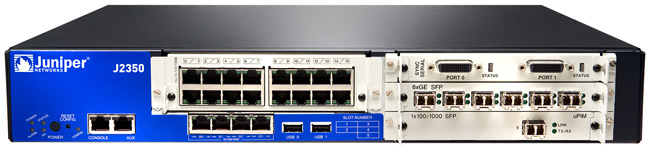
Juniper Networks J2350 Services Routers - Base Memory (512MB)
- JUNOS, 5 PIM Slots, SW Security, AC Power Supply, 19" Rack Mount
#J2350-JB-SC
List Price: $3,500.00
Juniper Networks J2350 Services Routers - Base Memory (512MB DRAM, 512 MB Flash) with DC Power Supply
- JUNOS,  5 PIM Slots, SW Encryption, DC Power Supply, 19" Rack Mount
#J2350-JB-SC-DC
List Price: $5,000.00
Juniper Networks J2350 Services Routers - High Memory (1GB DRAM, 512 MB Flash)
- JUNOS, 3 PIM Slots, HW Encryption, AC Power Supply, 19" Rack Mount
#J2350-JH
List Price: $5,000.00
Juniper Networks J2350 Services Routers - High Memory (1GB) with DC Power Supply
- JUNOS, 5 PIM Slots, HW Crypto, DC Power Supply, Fan Filter, 19" Rack Mount
#J2350-JH-DC
List Price: $6,500.00

More pricing below, click here


J2350 Overview:

The Juniper Networks J2350 is a modular router for enterprises running desktops, servers, VoIP, CRM/ERP/SCM applications. It offers five PIM slots for additional LAN/WAN connectivity, Avaya VoIP Gateway, and WAN acceleration.

Juniper Networks J Series Services Routers extend enterprise applications and deliver reliable connectivity to remote offices with a powerful blend of high-performance network protection and advanced services. J Series Services Routers leverage the modular JUNOS Software and Juniper’s rich product and partner portfolio to consolidate market leading security, application optimization, and voice capabilities onto a single, easy to manage platform. Our innovative security approach inseparably integrates routing and firewalls for exceptional performance. Available options, including integrated Juniper Networks WX application acceleration and integrated voice gateway technology from Avaya, make the J Series the ideal choice for closing the distance between central resources and remote locations.

Enterprises are faced with a number of challenges and opportunities by converging voice, video and data to one network. This consolidation of network elements reduces cost by easing deployment of SIP enabled VoIP, real-time high-definition Telepresence and standardizing on a consistent infrastructure network operating system like Juniper Networks® JUNOS® Software. These new technologies improve; customer relations, interactions with suppliers, and employee productivity. This mission-critical multi-media network must be always on and always available. To accomplish this, fully integrated stateful security is a key requirement, not merely forwarding packets without regard to the intended application or individual user session. JUNOS Software with enhanced services provides the high-performance networking infrastructure that helps enterprises implement key initiatives that:

  • Secure critical information and protect the network from vulnerabilities and attacks. Enterprises need to protect confidential information from external and internal attacks as they connect with their customers and suppliers. The inseparable routing and firewall offered by JUNOS Software with enhanced services secures every location in the network and allows departmental segmentation out to remote locations of the network. Implementing IPsec VPNs with firewalls at remote sites allows for flexible network connectivity with security for split tunneling configurations.
     
  • Minimize the cost of installing and operating the network. With the modular, protected mode design of JUNOS Software and the rigorous JUNOS Software development and testing process, there are fewer system process failures.
     
  • Superior configuration management reduces human errors that could lead to network downtime. The single code source of JUNOS Software makes the qualification of new releases across the network much simpler.
     
  • Simplify the operation of the branch network. JUNOS Software with enhanced services integrates best-in-class routing with best-in-class stateful inspection firewall. In addition, an active-active network topology provides stateful High Availability and systems level resiliency for mission critical networks. The Juniper Networks J Series Services Routers deliver “branch in a box” simplicity. This integrated package is easier to install, configure, and operate compared with discrete devices in the network.


Features & Benefits:

Key features of the J2350 router include the following:

  • Support for T1, E1, Synchronous Serial, ISDN BRI, ADSL/2/2+, G.SHDSL, and Gigabit Ethernet interfaces
  • Support for integrated IP telephony using the Avaya IG550 Integrated Gateway
  • Support for application acceleration using the Juniper Networks ISM200 Integrated Services Module
  • 4 fixed Gigabit Ethernet LAN ports, and 5 PIM slots
  • 512 MB DRAM default, expandable to 1 GB DRAM
  • 512 MB compact flash default, upgradeable to 1 GB
  • Hardware encryption acceleration (optional)
  • DC version available
  • NEBS-compliant models available

Key benefits of the J Series routers include the following:

  • Security - Juniper Networks delivers the most advanced set of mechanisms for fully protecting enterprise routers from outside threats. The J-series routers give network staff complete control even while under attack, with the console port always available to add new filters and policies with just a few fast and simple steps.
     
  • High uptime - The modular and fault-protected software design of the JUNOS operating system delivers high levels of resiliency and stability in the J-series routers. Unlike traditional enterprise routers, which any small bug can quickly spread into a larger problem, each software module in the JUNOS operating system runs independently and cannot impact other areas. Other resiliency features include next-generation CLI for accurate configuration, and a rescue button for fast system recovery.
     
  • Predictable performance - The J-series routers maintain high levels of QoS control and throughput when needed for the most demanding periods of network congestion. Modular software architectures are essential for the sorting and scheduling of traffic to ensure that the most important applications have first priority with networking resources.
     
  • Unmatched value - No licensing fees are required for advanced services such as IPv6, MPLS, IPSec and stateful firewall. No port licenses are required to operate onboard or modular interfaces.

Architecture and Key Components of JUNOS Software:


What is it? A single-source network OS that integrates routing, switching and security services for high-performance networks
Why does it matter? Competitors’ software hinders network enhancement for new business needs and drives up costs:
  • Monolithic software architectures—greater risk of downtime from software instabilities, performance degradation and security attacks with the inter-dependencies of co-mingled processes; requires repetitive tuning and fixes
  • Multiple release trains and software versions—needless complexity leads to feature inconsistency, including gaps in backwards compatibility, and the need for frequent fixes and extensive planning and testing for upgrades raises risks of human error
Why is it different?

With the release of 9.1, we have enhanced the JUNOS Software with a secure firewall and VPN module that combines the functionality of two boxes into one. This fundamental advancement in the architecture is based on the requirement that forwarding packets at wire-speed, while great in a lab with test equipment, may not be best practice in a real network where security threats can be propagated just as quickly. Simplifying the branch deployment by reducing multiple appliances or boxes performing specialized tasks like; stateful firewalling, security zones and Application Level Gateways, which reduces costs and manageability efforts. Juniper has taken the approach of integrating a flow based stateful firewall into the core of JUNOS Software in the J Series Services Routers for the branch to reduce the number of boxes, consolidate configurations onto one device and leverage the key intellectual property of ScreenOS® as an integral component of JUNOS Software.

Packet-Based Forwarding

A router’s main purpose is to connect clients and servers at wire speed with implied trust. This routing is performed on a packet by packet basis without regard to flow or state information. This architectural choice relies on firewalls to inspect traffic on a flow and state basis to determine potential attacks on the network of clients and servers. A router will keep track of TCP traffic session information with a simple hash algorithm to make sure that traffic that takes multiple links arrives at the destination in the correct order. This JUNOS Software architecture is based on deployments as the core operating systems on some of the Internet’s largest Tier 1 networks’ core routers. This architecture has the benefit of massive scaling since it has a fundamentally easier task of forwarding packets without regard to keeping track of individual flows or state. Service Providers have a different view of network topology compared to branch enterprises since they have many links between routers and locations. By forwarding traffic on a packet by packet basis, link utilization or link load balancing through various protocols (OSPF ECMP, OSPF TE, RSVP TE, IS-IS, BGP and MLPP) can be achieved to keep throughput within Service Level Agreement terms. The typical enterprise deployment of Virtual Router Redundancy Protocol (VRRP) runs two routers in an active-standby format, and if a link or router should fail, then the back-up link or router can be activated. This is a common deployment scenario for enterprise networks.

Session-Based Forwarding: Key Advancement

A firewall’s main purpose is to inspect traffic flows and state to ensure that returning information in the same session is expected and permitted. This architectural choice receives packets from a wide variety of clients and servers and keeps track of every session, of every application of every user. These flows can vary considerably based on the client/server loads as opposed to link load balancing of routers and the overall decentralized or centralized nature of the branch to headquarters/data center topology.

To secure all network connections, Juniper Networks J Series Services Routers with JUNOS Software with enhanced services devices use a dynamic packet filtering method known as stateful inspection. Using this method, the J Series Service Routers with JUNOS Software with enhanced services collect information on various components in a packet header—source and destination IP addresses, source and destination port numbers, and protocol. The J Series Services Routers then maintain the state of each TCP session or UDP pseudo-session traversing the firewall, performing TCP reassembly when necessary to ensure proper interpretation of the communication session. When a responding packet arrives, the firewall will compare the information reported in its header with the state of its associated session stored in the inspection table. If they match, the responding packet is allowed to pass the firewall. If the two do not match, the packet is dropped. The Juniper Networks firewall can secure a network by inspecting, and then allowing or denying, all connection attempts that require crossing an interface from and to that network.

By default, the Juniper Networks J Series Services Router with JUNOS Software with enhanced services denies all traffic in all directions, and this is in comparison to a router that forwards all traffic without regard to flow and state. Using centralized, policy-based management, enterprises can create a series of security policies that will control the traffic flow from clients to servers by defining the kinds of traffic permitted to pass from specified sources to specified destinations at scheduled times. At the broadest level, all types of traffic can be allowed from any source in security zones to any destination in all other zones without any scheduling restrictions. At the narrowest level, policies can be created that allow only one kind of traffic between a specified host in one zone and another specified host in another zone during a scheduled period of time.

High Availability

Figure 1: System redundancy in an active-passive configuration maintains all session information on a standby J Series Services Router in the event of a box failure. Network capacity is always one half of the maximum.

Figure 2: System redundancy in an active-active configuration maintains all session information load balanced across two active J Series Services Routers. Since Network capacity is load balanced, using all availablt resources when active-active and half the capacity in the event of a failure.

Stateful inspection is more secure than other firewall or Access Control List router technology such as packet filtering because it opens smaller “holes” through which traffic can pass. For example, instead of permitting any host or program to send any kind of TCP traffic on port 80, a stateful inspection firewall ensures that packets belong to an existing legitimate session. Furthermore, it can authenticate the user when the session is established, determine whether the packets really carry HTTP, and enforce granular constraints at the application layer (e.g., filtering URLs to deny access to black-listed sites).

By combining the JUNOS Services Redundancy Protocol (JSRP) and firewalling features, a pair of J Series Services Routers can be easily integrated into a High Availability network architecture, with redundant physical connections between the Services Routers and the adjacent networks. With link redundancy, Juniper Networks can address many common causes of system failures, such as a physical port going bad or a cable getting disconnected, to ensure the connection is available, without having to fail over the entire system. This is consistent with a typical active-standby nature of routing resiliency protocols.

When J Series Services Routers are configured as an active-active pair using JUNOS Software with enhanced services, traffic and configuration will be automatically mirrored to provide active firewall and VPN session maintenance. The J Series Services Routers can now synchronize both static information, such as the configuration, and dynamic run-time information. As a result, during failover, synchronization of the following information is shared: connection/session state and flow information, IPsec security associations, Network Address Translation (NAT traffic), address book information, configuration changes, and more. In contrast to the typical router active-standby resiliency protocols, VRRP for instance, in the event of a router failover all dynamic flow and session information is lost and must be reestablished. Some or all applications sessions will have to restart depending on the convergence time of the links or routers. J Series Services Routers with JUNOS Software with enhanced services, maintain state, and not only is the session preserved, but security is intact.

Session-Based Forwarding without the Performance Hit

In order to optimize the throughput and latency of the combined router and firewall, JUNOS Software with enhanced services implements session-based forwarding, an innovation that combines the session state information of a traditional firewall and the next-hop forwarding of a classic router into a single operation. With JUNOS Software, a session that is permitted by the forwarding policy is added to the forwarding table along with a pointer to the next-hop route. Established sessions have a single table lookup to verify that the session has been permitted and to find the next hop. This efficient algorithm improves throughput and lowers latency for session traffic when compared with a classic router that performs multiple table lookups to verify session information and then to find a next-hop route.

JUNOS Software with enhanced services brings high-performance routing together with best-in-class integrated security to branch locations in the distributed enterprise. JUNOS tightly integrates security services by bringing the power of sessions to deliver a true security device. This inseparable joining of routing and security improves performance and latency compared with classic routers. JUNOS Software with enhanced services is available on the Juniper Networks J Series Services Routers.

Figure 3 shows the session-based forwarding algorithm. When a new session is established, the session-based architecture within JUNOS Software verifies that the session is allowed by the forwarding policies. If the session is allowed, JUNOS will look up the next-hop route in the routing table. It inserts the session and the next-hop route into the session and forwarding table and forwards the packet. Subsequent packets for the established session require a single table lookup in the session and forwarding table, and are forwarded to the egress interface.

Figure 3: Session-Based Forwarding Algorithm

Important Notes

Juniper realizes that every customer may not be ready to make the change to JUNOS Software with enhanced services. We will continue to support packet based JUNOS Software according to our standard lifecycle policy and customers with support contracts can implement either version of JUNOS 9.1 at no additional cost. This, in the simplest terms, turns your router into a router plus a firewall for no additional costs. It is also important to realize that a configuration from packet-based JUNOS Software will need additional configuration to enable traffic to flow by implementing the appropriate security zone policies. This additional configuration is easily offset by the peace of mind of securing your traffic from network attack by using a best-in-class firewall, reduction in network elements (firewall), and active-active session synchronization in a pair topology (instead of active-standby).

Network Deployments

The J Series Services Routers are deployed at branch and remote locations in the network to provide all-in-one secure WAN connectivity, IP telephony, and connection to local PCs and servers via integrated Ethernet switching.

Operating System

All J Series Services Routers ship with the worldwide version of JUNOS Software, which has standard encryption, as opposed to the US and Canada version, which has strong encryption. You can download the strong encryption version at no charge so long as you can certify eligibility. The download is available from Juniper’s Customer Support Center Web site: https://www.juniper.net/customers/csc/software/.

Feature Licenses

Licenses are required to operate the J-Flow Accounting and Advanced BGP features on Juniper Networks J Series Services Routers. To acquire licenses, order JX-JFlow-ADV-LTU (for J-Flow Accounting) or JX-BGP-ADV-LTU (for Advanced BGP). Each license is good for one chassis.


Product Options:

Juniper Networks J2320, J2350, J4350, and J6350 Services Routers offer a number of options in terms of LAN and WAN ports, hardware encryption acceleration, power supplies, DRAM, compact flash, and feature licenses.

LAN Ports

All J2320, J2350, J4350, and J6350 Services Routers ship with four fixed 10/100/1000 Ethernet ports. You can add more modular LAN interfaces by ordering the appropriate PIMs, Enhanced PIMs (EPIMs), or Universal PIMs (UPIMs).

WAN Ports

All J2320, J2350, J4350, and J6350 Services Routers ship without fixed WAN ports. The customer can add modular WAN interfaces by ordering the appropriate PIMs.

Hardware Encryption Acceleration

The J2320, J2350, and J4350 are available with optional hardware encryption acceleration. All J6350 models include hardware encryption acceleration by default. If you purchase a J2320, J2350, or J4350 without hardware encryption, you can add it later by ordering the appropriate encryption card.

Power Supply

All J2350, J4350, and J6350 Services Routers ship with either a DC power supply or an AC power supply and include a region-specific power cord. (The J2320 is available with AC power only.) The J6350 supports a second redundant AC or DC power supply, which can be added by ordering SSG-PS-DC or SSG-PS-AC. The region-specific AC power cable for SSG-PS-AC must be ordered separately.

DRAM

The J2320 and J2350 are upgradeable to a maximum of 1 GB DRAM. The J2320 and J2350 models without hardware encryption acceleration (J2320-JB-SC and J2350-JB-SC) come with 512 MB DRAM. All other models come with 1 GB of DRAM.

All J4350 models are upgradeable to a maximum of 2 GB DRAM. The J4350 model that ships without hardware encryption acceleration (J-4350-JB-SC) ships with 512 MB of DRAM. All other J4350 models ship with 1 GB of DRAM.

All J6350 Services Routers ship with 1 GB of DRAM and are upgradeable to 2 GB of DRAM. Order and install two additional JXX50-MEM-512M-S DIMMs.

Note that when upgrading DRAM, DIMMs should always be installed in pairs; for example, to upgrade to 1 GB DRAM, order two JXX50-MEM-512M-S DIMMs. To upgrade to 2 GB DRAM, order four JXX50-MEM-512M-S DIMMs.

With JUNOS Release 9.1 and later, all J Series Services Routers (J2320, J2350, J4350, J6350) must run at least 512 MB of DRAM.

Compact Flash

All J2320, J2350, J4350, and J6350 Services Routers ship with 512 MB of primary compact flash. You can replace that with a larger compact flash by ordering one either JX-CF-512M-S (for 512 MB) or JX-CF-1G-S (for 1 GB).


Diagram:

A typical network scenario is depicted for a distributed or branch enterprise. By using IPsec VPNs over the Internet, remote sites, branch offices, small datacenters and the headquarters are all connected as if they were in the same location. variety of WAN connections are depicted.


Technical Specifications:

Model: J2320 J2350 J4350 J6350

Dimensions and Power
Size (W x H x D) 17.5 x 1.75 x 15.1 in (445 x 44 x 383 mm) 17.5 x 1.75 x 15.1 in (445 x 44 x 383 mm) 17.5 x 3.5 x 21.5 in (445 x 89 x 546 mm) 17.5 x 3.5 x 21.5 in (445 x 89 x 546 mm)
Weight 15 lb (6.8 kg) No interface modules, 16.6 lb (7.6 kg) 3 interface modules 16 lb (7.3 kg) No interface modules,
19 lb (8.6 kg) 5 interface modules
23 lb (10.4 kg) No interface modules, 25.3 lb (11.5 kg) 6 interface modules 25 lb (11.3 kg) No interface modules,
1 power supply 30.7 lb (13.9 kg) 6 interface modules, 2 power supplies
Rack mountable Yes, 1RU Yes, 1.5RU Yes, 2RU Yes, 2RU
Power supply (AC) 100 to 240 VAC, 275 watts 100 to 240 VAC, 300 watts 100 to 240 VAC, 350 watts 100 to 240 VAC, 420 watts
Average power consumption 80 W 80 W 143 W 166 W
Input frequency 47–63 Hz 47–63 Hz 47–63 Hz 47–63 Hz
Maximum current consumption 3.2 A @ 100 VAC 3.5 A @ 90 VAC 5.7 A @ 100 VAC 5.7 A @ 90 VAC
Maximum inrush current 42 A 32 A 32 A 30 A
Average heat dissipation 273 BTU/hour 273 BTU/hour 488 BTU/hour 566 BTU/hour
Maximum heat dissipation 1091 BTU/hour 1195 BTU/hour 1070 BTU/hour 1145 BTU/hour
Power supply (DC) - -48 to -60 VDC, 300 W -48 to -60 VDC, 420 W -48 to -60 VDC, 420 W
Redundant power supply (hot swappable) No No No Yes
Noise level 40.0 dB 59.2 dB 59.3 dB 61.2 dB
Certifications
Safety Certifications UL, CUL, CSA, CB UL, CUL, CSA, CB UL, CUL, CSA, CB UL, CUL, CSA, CB
Electromagnetic Compatibility (EMC) Certifications FCC class B, CE class A, C-Tick, VCCI class B FCC class B, CE class A, C-Tick, VCCI class B FCC class B, CE class A, C-Tick, VCCI class B FCC class B, CE class A, C-Tick, VCCI class A
Environment
Operating Temperature 32°–122° F
(0°–50° C)
32°–122° F
(0°–50° C)
32°–122° F
(0°–50° C)
32°–122° F
(0°–50° C)
Non-Operating Temperature 4°–158° F
(-20°–70° C)
4°–158° F
(-20°–70° C)
4°–158° F
(-20°–70° C)
4°–158° F
(-20°–70° C)
Humidity 10%–90% noncondensing 10%–90% noncondensing 10%–90% noncondensing 10%–90% noncondensing
Mean time between failure (Bellcore model) 7.2 years 6.8 years 7.6 years 12 years with redundant power
Other - NEBS Level 3 NEBS Level 3 NEBS Level 3


Model: J2320 J2350 J4350 J6350

Maximum Performance and Capacity
JUNOS Software version support JUNOS 9.1 JUNOS 9.1 JUNOS 9.1 JUNOS 9.1
Firewall performance (Large packets) 600 Mbps 750 Mbps 1.6 Gbps 2 Gbps
Firewall performance (IMIX) 400 Mbps 500 Mbps 600 Mbps 1 Gbps
Firewall + Routing packets per second (64 byte) 175000 pps 200000 pps 225000 pps 400000 pps
Advanced Encryption Standard (AES) 256+SHA-1 VPN performance 140 Mbps 160 Mbps 600 Mbps 1 Gbps
3DES encryption +SHA-1 VPN performance 140 Mbps 160 Mbps 600 Mbps 1 Gbps
Maximum concurrent sessions (512MB/1GB DRAM) 512 MB / 1 GB DRAM 64 K / 128 K 512 MB / 1 GB DRAM 64 K / 128 K 512 MB / 1 GB DRAM 64 K / 128 K 512 MB / 1 GB DRAM 256 K / 256 K
New sessions/second 5,000 5,000 10,000 20,000
Maximum security policies 2048 (1 GB DRAM) 2048 (1 GB DRAM) 5192 (1 GB DRAM) 10384 (1 GB DRAM)
Firewall
Network attack detection Yes Yes Yes Yes
DoS and DDoS protection Yes Yes Yes Yes
TCP reassembly for fragmented packet protection Yes Yes Yes Yes
Brute force attack mitigation Yes Yes Yes Yes
SYN cookie protection Yes Yes Yes Yes
Zone-based IP spoofing Yes Yes Yes Yes
Malformed packet protection Yes Yes Yes Yes
VoIP Security
H.323. Application-level gateway (ALG) Yes Yes Yes Yes
SIP ALG Yes Yes Yes Yes
MGCP ALG Yes Yes Yes Yes
SCCP ALG Yes Yes Yes Yes
Network Address Translation (NAT) for VoIP protocols Yes Yes Yes Yes
Routing
BGP instances 20 25 30 30
BGP peers 512 MB / 1 GB DRAM 40 / 40 512 MB / 1 GB DRAM 40 / 40 512 MB / 1 GB DRAM 40 / 40 1 GB / 2 GB DRAM
40 / 40
BGP routes 512 MB / 1 GB DRAM 100 K / 300 K 512 MB / 1 GB DRAM 100 K / 300 K 512 MB / 1 GB DRAM 100 K / 300 K 1 GB / 2 GB DRAM 100 K / 300 K
OSPF instances 20 / 20 25 / 25 30 / 30 30 / 30
OSPF routes 512 MB / 1 GB DRAM 5 K / 10 K 512 MB / 1 GB DRAM 5 K / 10 K 512 MB / 1 GB DRAM 5 K / 10 K 1 GB DRAM
10 K
RIP v1/v2 instances 20 / 20 25 / 25 30 / 30 30 / 30
RIP v2 routes 512 MB / 1 GB DRAM 5 K / 10 K 512 MB / 1 GB DRAM 5 K / 10 K 512 MB / 1 GB DRAM 5 K / 10 K 1 GB DRAM
10 K
Static routes 512 MB / 1 GB DRAM 5 K / 10 K 512 MB / 1 GB DRAM 5 K / 10 K 512 MB / 1 GB DRAM 5 K / 10 K 1 GB DRAM
10 K
Source-based routing Yes Yes Yes Yes
Policy-based routing Yes Yes Yes Yes
Equal-cost multipath (ECMP) Yes Yes Yes Yes
Multicast Yes Yes Yes Yes
Reverse Path Forwarding (RPF) Yes Yes Yes Yes
Internet Group Management Protocol (IGMP) (v1,v2, v3) Yes Yes Yes Yes
PIM single mode Yes Yes Yes Yes
PIM source-specific multicast Yes Yes Yes Yes
Multicast inside IPsec tunnel Yes Yes Yes Yes
IPsec VPN
Concurrent VPN tunnels (512MB/1GB DRAM) 512 MB / 1 GB DRAM 256 / 512 512 MB / 1 GB DRAM 256 / 512 512 MB / 1 GB DRAM 256 / 512 1 GB / 2 GB DRAM 512 / 1024
Tunnel interfaces 512 MB / 1 GB DRAM 256 / 512 512 MB / 1 GB DRAM 256 / 512 512 MB / 1 GB DRAM 256 / 512 1 GB / 2 GB DRAM 512 / 1024
DES encryption (56-bit), 3DES encryption (168-bit) and Advanced Encryption Standard (AES) (256-bit) Yes Yes Yes Yes
MD-5 and SHA-1 authentication Yes Yes Yes Yes
Manual key, IKE, PKI (X.509) Yes Yes Yes Yes
Perfect forward secrecy (DH Groups) (512MB/1GB DRAM) Yes Yes Yes Yes
Prevent replay attack Yes Yes Yes Yes
Remote access VPN Yes Yes Yes Yes
Layer2 Tunneling Protocol (L2TP) within IPsec No No No No
IPsec (NAT) traversal Yes Yes Yes Yes
Redundant VPN gateways Yes Yes Yes Yes
User Authentication and Access Control
Built-in (internal) database - user limit        
Third-party user authentication RADIUS, RSA, SecureID, LDAP RADIUS, RSA, SecureID, LDAP RADIUS, RSA, SecureID, LDAP RADIUS, RSA, SecureID, LDAP
RADIUS Accounting Yes Yes Yes Yes
XAUTH VPN authentication Yes Yes Yes Yes
Web-based authentication Yes Yes Yes Yes
802.1X authentication (JUNOS 9.2) Yes Yes Yes Yes
PKI Certificate requests (PKCS 7 and PKCS 10) Yes Yes Yes Yes
Certificate Authorities supproted VeriSign, Entrust, Microsoft, RSA Keon, iPLanet, (Netscape), Baltimore, DoD PKI VeriSign, Entrust, Microsoft, RSA Keon, iPLanet, (Netscape), Baltimore, DoD PKI VeriSign, Entrust, Microsoft, RSA Keon, iPLanet, (Netscape), Baltimore, DoD PKI VeriSign, Entrust, Microsoft, RSA Keon, iPLanet, (Netscape), Baltimore, DoD PKI
Virtualization
Maximum number of security zones 40 50 50 50
Maximum number of virtual routers 20 25 30 30
Bridge groups* Yes Yes Yes Yes
Maximum number of VLANs 256 256 512 1024
Encapsulations
Point-to-Point Protocol (PPP) Yes Yes Yes Yes
Multilink Point-to-Point Protocol (MLPPP) Yes Yes Yes Yes
MLPPP max physical interfaces 6 10 12 12
Frame Relay Yes Yes Yes Yes
Multilink Frame (MLFR) (FRF 15, FRF 16) Yes Yes Yes Yes
MLFR max physical interfaces 6 10 12 12
HDLC Yes Yes Yes Yes
Mode of Operation
Layer 2 (transparent) mode(5) No No No No
Layer 3 (route and/or NAT) mode Yes Yes Yes Yes
Address Translation
Network Address Translation (NAT) Yes Yes Yes Yes
Port Translation (PAT) Yes Yes Yes Yes
Policy-based NAT/PAT Yes Yes Yes Yes
Mapped IP (MIP) Yes Yes Yes Yes
Virtual IP (VIP) Yes Yes Yes Yes
MIP/VIP Grouping Yes Yes Yes Yes
IP Address Assignment
Static Yes Yes Yes Yes
DHCP, PPPoE client Yes Yes Yes Yes
Internal DHCP server Yes Yes Yes Yes
DHCP relay Yes Yes Yes Yes
Traffic Management Quality of Service (QoS)
Guaranteed bandwidth Yes Yes Yes Yes
Maximum bandwidth Yes Yes Yes Yes
Ingress traffic policing Yes Yes Yes Yes
Priority-bandwidth utilization Yes Yes Yes Yes
Differv marking Yes Yes Yes Yes
High Availability (HA)
Active/Active - L3 mode Yes Yes Yes Yes
Active/Passive -L3 mode Yes Yes Yes Yes
Configuration synchronization Yes Yes Yes Yes
VRRP Yes Yes Yes Yes
Session synchronization for firewall and VPN Yes Yes Yes Yes
Session failover for routing change Yes Yes Yes Yes
Device failure detection Yes Yes Yes Yes
Link failure detection Yes Yes Yes Yes
Network Connectivity
Fixed I/O 4 x 10/100/1000 4 x 10/100/1000 4 x 10/100/1000 4 x 10/100/1000
Maximum PIM slots 3 5 6 6
Maximum EPIM slots 0 0 2 4
Flash and Memory
Memory minimum and maximum (DRAM) 512 MB, 1GB 512 MB, 1GB 512 MB, 1GB 1GB, 2GB
Memory slots 4 4 4 4
Compact flash minimum and maximum 512 MB, 1 GB 512 MB, 1 GB 512 MB, 1 GB 512 MB, 1 GB
USB port for external storage Yes Yes Yes Yes

*Bridge groups supported only on uPIMs in ScreenOS 6.0 and greater releases

J Series Comparison Matrix:


Model: J2320 J2350 J4350 J6350

Maximum Performance and Capacity
JUNOS Software version support JUNOS 9.1 JUNOS 9.1 JUNOS 9.1 JUNOS 9.1
Firewall performance (Large packets) 600 Mbps 750 Mbps 1.6 Gbps 2 Gbps
Firewall performance (IMIX) 400 Mbps 500 Mbps 600 Mbps 1 Gbps
Firewall + Routing packets per second (64 byte) 175000 pps 200000 pps 225000 pps 400000 pps
3DES encryption +SHA-1 VPN performance 140 Mbps 160 Mbps 600 Mbps 1 Gbps
Concurrent VPN Tunnels 512 MB / 1 GB DRAM 256 / 512 512 MB / 1 GB DRAM 256 / 512 512 MB / 1 GB DRAM 256 / 512 1 GB / 2 GB DRAM
Maximum concurrent sessions 512 MB / 1 GB DRAM 64 K / 128 K 512 MB / 1 GB DRAM 64 K / 128 K 512 MB / 1 GB DRAM 64 K / 128 K 512 MB / 1 GB DRAM 256 K / 256 K
New sessions/second 5,000 5,000 10,000 20,000
Maximum security policies 2048 (1 GB DRAM) 2048 (1 GB DRAM) 5192 (1 GB DRAM) 10384 (1 GB DRAM)
Routing, Virtualization, Encapsulations
BGP, OSPF, RIP, Static, ECMP Yes Yes Yes Yes
Multicast, PIM SM, SSM,IGMP Yes Yes Yes Yes
Maximum Number of Security Zones 40 50 50 50
Maximum Number of Virtual Routers Yes Yes Yes Yes
Maximum Number of VLANs 256 256 512 1024
PPP, FR, MLPP, MLFR, HDLC Yes Yes Yes Yes
Network Connectivity
Fixed I/O 4 x 10/100/1000 4 x 10/100/1000 4 x 10/100/1000 4 x 10/100/1000
Maximum PIM slots 3 5 6 6
Maximum EPIM slots 0 0 2 4


Documentation:


Download the Juniper Networks J Series Services Routers Datasheet (PDF).


Juniper Products
J Series Appliances
Juniper Networks J2350 Services Routers - Base Memory (512MB)
- JUNOS, 5 PIM Slots, SW Security, AC Power Supply, 19" Rack Mount
#J2350-JB-SC
List Price: $3,500.00
Juniper Networks J2350 Services Routers - Base Memory (512MB DRAM, 512 MB Flash) with DC Power Supply
- JUNOS,  5 PIM Slots, SW Encryption, DC Power Supply, 19" Rack Mount
#J2350-JB-SC-DC
List Price: $5,000.00
Juniper Networks J2350 Services Routers - High Memory (1GB DRAM, 512 MB Flash)
- JUNOS, 3 PIM Slots, HW Encryption, AC Power Supply, 19" Rack Mount
#J2350-JH
List Price: $5,000.00
Juniper Networks J2350 Services Routers - High Memory (1GB) with DC Power Supply
- JUNOS, 5 PIM Slots, HW Crypto, DC Power Supply, Fan Filter, 19" Rack Mount
#J2350-JH-DC
List Price: $6,500.00
Juniper Content Subscriptions
First Year Subscriptions Main Office Content Security
One Year Security Subscription for Enterprise on J2350
- Includes Antivirus, Web Filtering, Antispam and IDP
#J2350-SMB-CS
List Price: $4,125.00
Three Year Security Subscription for Enterprise on J2350
- Includes Antivirus, Web Filtering, Antispam and IDP
#J2350-SMB-CS-3
List Price: $9,488.00
Renewal Subscriptions Main Office Content Security
One Year Renewal Security Subscription for Enterprise on J2350
- Includes Antivirus, Web Filtering, Antispam and IDP
#J2350-SMB-CS-R
List Price: $4,125.00
Three Year Renewal Security Subscription for Enterprise on J2350
- Includes Antivirus, Web Filtering, Antispam and IDP
#J2350-SMB-CS-3-R
List Price: $9,488.00

Use our Quote Form to request additional subscription pricing

Juniper Accessories
Interface Modules
1-Port ADSL2+ Annex A PIM, Supporting ADSL/ADSL2/ADSL2+ Annex A #JX-1ADSL-A-S
List Price: $750.00
1-Port ADSL2+ Annex B PIM, Supporting ADSL/ADSL2/ADSL2+ Annex B #JX-1ADSL-B-S
List Price: $750.00
2 Port Channelized T1/E1 PIM #JX-2CT1E1-RJ45-S
List Price: $1,300.00
2 Port E1 PIM with integrated CSU/DSU #JX-2E1-RJ48-S
List Price: $1,000.00
2 Port Serial PIM #JX-2Serial-S
List Price: $700.00
2 Port 2-wire or 1 Port 4-wire G.SDHSL PIM #JX-2SHDSL-S
List Price: $950.00
2 Port T1 PIM with integrated CSU/DSU #JX-2T1-RJ48-S
List Price: $1,000.00
4xISDN BRI - S Interface #JX-4BRI-S-S
List Price: $1,100.00
4xISDN BRI - U Interface #JX-4BRI-U-S
List Price: $1,500.00
SFP 100BASE-FX Optical Transceiver, LC connector #JX-SFP-1FE-FX
List Price: $250.00
SFP 1000Base-LH Gigabit Optical Tranceiver SFP Module #JX-SFP-1GE-LH
List Price: $6,000.00
SFP 1000Base-LX Gigabit Optical Tranceiver SFP Module #JX-SFP-1GE-LX
List Price: $995.00
SFP 1000Base-SX Gigabit Optical Tranceiver Module #JX-SFP-1GE-SX
List Price: $500.00
SFP 1000BASE-T Gigabit Copper Transceiver SFP Module #JX-SFP-1GE-T
List Price: $400.00
16 Port Gigabit Ethernet 10/100/1000 Copper Double-height Universal PIM #JXU-16GE-TX-S
List Price: $3,000.00
1 port Small Form-Factor pluggable (SFP) Universal Physical Interface Module.
(SFP Tranceiver purchased separately)
100M and 1000M SFP speeds supported.
#JXU-1SFP-S
List Price: $1,500.00
6 Port SFP Gigabit Ethernet Universal PIM
Note SFPs sold separately. Supports 1000M SFPs only
#JXU-6GE-SFP-S
List Price: $3,000.00
8 Port Gigabit Ethernet 10/100/1000 Copper Universal PIM #JXU-8GE-TX-S
List Price: $1,800.00
Power Cables
Power Cable - Spare - Type B, NEMA 5-15 (North American 15A/125V grounded) #CBL-JX-PWR-US
List Price: $50.00
WAN Optimization Services Module and License Upgrades
Upgrade ISM200-WXC, Enable Encryption Services License (SSL) #ENC-ISM200-WXC
List Price: $795.00
Upgrade a JX-ISM-200-WXC from 2Mbps to 10Mbps #WXOS-ISM200-2-10
List Price: $6,500.00
Upgrade a JX-ISM-200-WXC from 2Mbps to 4Mbps #WXOS-ISM200-2-4
List Price: $2,500.00
Upgrade a JX-ISM-200-WXC from 4Mbps to 10Mbps #WXOS-ISM200-4-10
List Price: $4,500.00
Upgrade a JX-ISM-200-WXC from 512Kbps to 10Mbps #WXOS-ISM200-512K-10
List Price: $6,000.00
Upgrade a JX-ISM-200-WXC from 512Kbps to 2Mbps #WXOS-ISM200-512K-2
List Price: $2,000.00
Upgrade a JX-ISM-200-WXC from 512Kbps to 4Mbps #WXOS-ISM200-512K-4
List Price: $3,000.00
Memory
256MB Memory Module #J-MEM-256M-S
List Price: $600.00
512MB Memory Module #J-MEM-512M-S
List Price: $1,000.00
Compact Flash
128M Compact Flash for J-Series #JX-CF-128M-S
List Price: $300.00
256M Compact Flash for J-Series #JX-CF-256M-S
List Price: $400.00
512M Compact Flash for J-Series #JX-CF-512M-S
List Price: $800.00
1G Compact Flash for J-Series #JX-CF-1G-S
List Price: $1,600.00
Licenses
DLSw Licenses have been discontinued and is now included in the base system. License no longer required.
For DC-Power-Supply or NEBS-Compliant systems please refer to the TAA section.
Advanced BGP License for J-Series #JX-BGP-ADV-LTU
List Price: $2,000.00
Accessories
J2350 to SSG 350M Conversion Kit #J2350-SSG-CONV-S
List Price: $1,000.00
Blank Spare plate for J-Series and SSG 100-300 Series #JX-Blank-FP-S
List Price: $30.00
EIA530 cable (DCE) #JX-CBL-EIA530-DCE
List Price: $100.00
EIA530 cable (DTE) #JX-CBL-EIA530-DTE
List Price: $100.00
RS232 cable (DCE) #JX-CBL-RS232-DCE
List Price: $100.00
RS232 cable (DTE) #JX-CBL-RS232-DTE
List Price: $100.00
RS449 cable (DCE) #JX-CBL-RS449-DCE
List Price: $100.00
RS449 cable (DTE) #JX-CBL-RS449-DTE
List Price: $100.00
V.35 cable (DCE) #JX-CBL-V35-DCE
List Price: $100.00
V.35 cable (DTE) #JX-CBL-V35-DTE
List Price: $100.00
X.21 cable (DCE) #JX-CBL-X21-DCE
List Price: $100.00
X.21 cable (DTE) #JX-CBL-X21-DTE
List Price: $100.00
RJ-45 to DB9 connector used for serial console interface #JX-CONN-DB9
List Price: $10.00
J2320, J2350 Hardware Crytographic Acceleration Module #JXH-HC2-S
List Price: $1,000.00
SSG 350M & J2350 Air Filter - Required for NEBS compliance #SSG-350M-FLTR
List Price: $175.00
1 Gigabyte RAM Memory Upgrade for the SSG 500 series, SSG 300 series, J2320, J2350, J4350, J6350 #SSG-500-MEM-1GB
List Price: $2,000.00


Home | Products | Search | View Cart | Shipping | Return Policy | Terms & Conditions | Privacy Policy | Contact Us

NetworkScreen.com is a division of Virtual Graffiti Inc, an authorized Juniper reseller.
Copyright © 1999-2010 Juniper Networks, Inc. All rights reserved.