

|

|
EX8200 Ethernet Switches |
Juniper Networks Base EX8216 system configuration
16-slot chassis with passive midplane and 2x fan trays, 1x routing engine, 8x switch fabric modules, 2x 3000W AC PSUs with power cords, and all necessary blank panels |
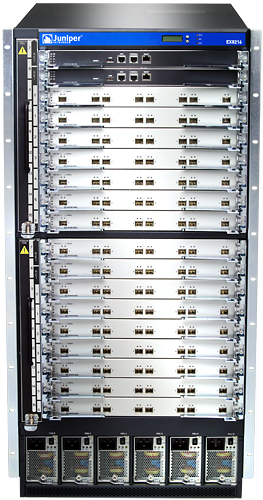
#EX8216-BASE-AC
List Price: $76,000.00 |
|
More pricing below,
click here
EX8216 Overview:
The EX8216 Ethernet Switch, a member of Juniper Networks
EX Series Ethernet Switches product family, delivers the performance, scalability, and high availability required for today’s high-density data center, cloud computing,
and Internet exchange environments. The EX8216 modular switch scales to a total capacity of 12.4 terabits per second (Tbps), making it the highly scalable solution
required by today’s high-performance networks while providing sufficient capacity to support the most demanding network environments in the future.
The 16-slot Juniper Networks® EX8216 Ethernet Switch, part of the Juniper Networks EX8200 line of Ethernet Switches, offers a high-density, high-performance platform
for aggregating access switches deployed in data center top-of-rack or end-of-row applications, as well as for supporting Gigabit Ethernet server access in data center
end-of-row deployments. The EX8216 delivers approximately 1.9 billion packets per second (Bpps) of high-density, wire-speed 10-Gigabit Ethernet performance for the
largest data center networks.
To maximize network investments, the EX8216 leverages the same EX8200 wire-speed line cards and power supplies used by the eight-slot Juniper Networks EX8208 Ethernet
Switch, ensuring consistent performance across the entire product family. Working with the EX8208, as well as Juniper Networks EX4200 and EX3200 lines of Ethernet switches
which all run the same Juniper Networks JUNOS® Software operating system, the EX8216 helps reduce capital and operational expenses across the data center infrastructure.
EX8216 Ethernet Switch
The EX8216 modular switch includes an advanced set of hardware features enabled by the Juniper-designed EX-PFE2 ASIC. Working with the carrier-class JUNOS Software, the
EX-PFE2 ASICs on each line card deliver the scalability needed to support high-performance data center networks.
The EX8216 switch can accommodate any combination of EX8200 line Ethernet line cards. Options include the following:
- EX8200-48T: a 48-port 10/100/1000BASE-T RJ-45 unshielded twisted pair (UTP) line card
- EX8200-48F: a 48-port 100BASE-FX/1000BASE-X SFP fiber line card
- EX8200-8XS: an eight-port 10GBASE-X SFP+ fiber line card
Fully configured, a single EX8216 chassis can support up to 768 Gigabit Ethernet or 128 10-Gigabit Ethernet ports at wire speed for all packet sizes, delivering one of
the highest line-rate 10-Gigabit Ethernet port densities in the industry.
At 21 rack units (RUs) high, two EX8216 switches can fit in a standard 42 RU rack, enabling up to 1,536 line-rate Gigabit Ethernet or 256 line-rate 10-Gigabit Ethernet
ports in a single rack. In addition, the EX8216 is just 26.5 inches deep, enabling it to fit into typical data center cabinets and making it ideal for existing infrastructures or in locations where space is at
a premium.
The EX8216 switch fabric is capable of delivering 320 Gbps (full duplex) per slot, enabling scalable wire-rate performance on all ports for any packet size. The passive
backplane design supports a future capacity of up to 12.4 Tbps, providing a built-in migration path to next-generation deployments.
The base configuration of the EX8216 switch includes two side-mounted, hot-swappable fan trays with variable-speed fans, one Routing Engine module, and eight dedicated
switch fabric modules (SFMs). The base EX8216 also ships with two 3,000 watt power supplies, although six power supply bays allow users to provision the chassis to provide
the power and redundancy required for any type of deployment. A redundant EX8216 configuration adds a second Routing Engine module to provide hot standby resiliency, as well
as a full complement of six power supplies, providing complete redundancy and availability. Except for the switch fabric modules, all components are accessible from the front,
simplifying operations, maintenance, and upgrades.
A front-panel chassis level LCD displays Routing Engine status as well as chassis component alarm information for rapid problem identification and resolution. The LCD also
provides a flexible, user-friendly interface for performing device initialization and configuration rollbacks, reporting system status and alarm notifications, or restoring
the switch to its default settings.
Deployment Scenarios
The EX8216 modular switch is designed for a variety of data center deployments, providing a high-performance, high-density core platform that reduces cost and complexity
while improving overall scalability and offering carrier-class reliability.
Populated entirely with 10-Gigabit Ethernet line cards, a single EX8216 Ethernet Switch can accommodate up to 128 high-speed, line-rate uplinks from access-layer devices
such as EX4200 switches deployed in Virtual Chassis top-of-rack configurations, delivering a highly scalable solution that can support more servers with fewer actual switches.
A single EX8216 chassis can also support up to 768 Gigabit Ethernet ports to serve as a highly effective, end-of-row server access switch.
The high Gigabit Ethernet and 10-Gigabit Ethernet port densities on the EX8216 enable the consolidation of aggregation and core layers, dramatically simplifying data center
architectures and reducing total cost of ownership (TCO) while lowering power, space, and cooling requirements.

Features at a Glance:
| Features |
Description |
|
Chassis |
- 21 RU; 26.5 in (67.4 cm) deep; 17.3 in (43.9 cm) wide
- 16 dedicated I/O slots
- 12.4 Tbps backplane capacity
- Dedicated data, control, and management planes
- LCD panel for system monitoring
|
|
Power |
- Energy efficiency: up to 205,000 packets per second per watt
- 6 load sharing power supplies
- 15,000 W maximum power configuration
- 220 VAC N+1 or N+N redundancy
|
|
Cooling |
- Redundant fans and controllers
- Side-to-side airflow
|
|
Fabric |
- 320 Gbps (full duplex) per slot fabric capacity
- Eight active fabric cards for N+1 redundancy
- Full line-rate forwarding even under failure conditions
|
|
Routing Engine |
- 1+1 redundancy
- Master and backup SREs
- 2 gigabytes DRAM; 2 gigabytes Flash memory
- Console + auxiliary serial and Ethernet management ports
- USB storage interface
|
|
Operating System |
|
|
High Availability |
Hardware designed for continuous operation:
- Secure, modular architecture isolates faults
- Separate control and forwarding planes enhance scalability and resiliency
- Transparent failover and network recovery
- Graceful Route Engine Switchover (GRES)
- Nonstop Routing (NSR)*
|
|
Layer 2 Features |
- Jumbo frames (9216 Bytes)
- 4,096 VLANs
- VLAN Registration Protocol (GVRP)
- 802.3ad – Link Aggregation Control Protocol (LACP)
- 802.1D – Spanning Tree Protocol
- 802.1w – Rapid Spanning Tree
- 802.1s – Multiple Instance Spanning Tree
- Redundant Trunk Group (RTG)
- VLAN Spanning Tree Protocol (VSTP)
|
|
Layer 3 Features |
- Static routing
- RIP v1/v2
- OSPF v2
- Virtual Router Redundancy Protocol (VRRP)
- BGP (Advanced Feature license)
- IS-IS (Advanced Feature license)
- IPv6 (Advanced Feature license – roadmap)*
- Bidirectional Forwarding Detection protocol (BFD)
|
|
Hardware Tunneling |
- GRE tunnels (Advanced feature
license – roadmap)*
- MPLS capabilities (Advanced feature license – roadmap)*
|
|
Multicast |
- Internet Group Management Protocol (IGMP)
v1/v2/v3
- IGMP snooping
- Protocol Independent Multicast PIM-SM, PIM-SSM, PIM-DM, MSDP
|
|
Firewall Filters |
- Ingress & egress L2-L4 access control lists (ACLs):
- Port ACLs
- VLAN ACLs
- Router ACLs
- Control plane denial of service (DoS) protection
|
|
Quality of Service (QoS) |
- 2,000 policers per chassis
- 8 egress queues per port
- Weighted Random Early Drop (WRED) scheduling
- Scheduled weighted round-robin (SWRR) queuing
- Strict priority queuing
- Multi-field classification (L2 – L4) for scheduling and rewrite
|
|
Management |
- JUNOS Software command-line interface (CLI)
- JUNOScript
- Embedded Web-based management (Juniper Networks J-Web Software)
- Network and Security Manager (NSM) support
- LCD panel
- SNMP v1/v2/v3
- RADIUS
- TACACS+
- Extensive MIB support
- Local and remote analyzer (mirroring)
- Link Layer Discovery Protocol (LLDP)
- Advanced Insight Solutions (AIS)
|
* Roadmap
Architecture and Key Components:
Juniper Networks EX8200 line of Ethernet switches, including the EX8216 and EX8208, share a number of distinct architectural elements. The Routing Engines employed
by these switches run JUNOS Software, which processes all Layer 2 and Layer 3 protocols and manages individual chassis components, while the switch fabrics provide
the central crossbar matrix through which all data traffic passes.
The EX8200 line cards, which are common across all EX8200 platforms, include ASIC-based packet forwarding engines—the EX-PFE2—that process network traffic at wire
rates, as well as a line-card processor that provides scalable local control.
The EX8216 architecture was designed for very large data center deployments, with no head-of-line blocking, a single-tier low-latency switch fabric, efficient multicast
replication handling, and deep buffering to ensure performance at scale. The EX8216 chassis midplane distributes the control and management plane signals over independent
paths to the various system components and distributes power throughout the system. Data plane signals pass directly from the EX8200 line cards to the EX8216 switch fabric
modules via a unique connector system that provides unparalleled signal quality for future generations of fabric technologies.
To maintain uninterrupted operation, the EX8216 switch’s two fan trays cool the line cards, Routing Engine, and switch fabric modules with redundant, variable speed fans.
The EX8200 line’s power supplies convert building power to the internal voltage required by the system.
All EX8216 components are hot-swappable, and all central functions are available in redundant configurations, providing high operational availability by allowing continuous
system operation during maintenance or repairs.
Routing Engine Module
The EX8216 Routing Engine module supports control and management plane functionality with an integrated Routing Engine that features a 1.2 GHz PowerPC processor with 2 gigabytes
of DRAM and 2 gigabytes of flash storage. A dedicated front-panel RJ-45 Gigabit Ethernet port on the Routing Engine module supports out-of-band system management and monitoring, while
an external USB port allows easy uploading and storage of software images, configuration files, and logs. Direct console access is available through a dedicated serial port, while an
auxiliary console interface can support remote modem access to the switch.
The EX8216 switch’s Routing Engine is based on the same field-proven hardware architecture used by Juniper Networks routers, bringing the same carrier-class performance and reliability
to the EX8216 that Juniper’s routers bring to the world’s largest service provider networks. The Routing Engine’s central CPU performs all system control functions and maintains hardware
forwarding table and routing protocol states for the EX8216 switch. Dedicated hardware on the Routing Engine module supports chassis management functions such as environmental monitoring,
while communication between Routing Engine modules and individual line cards takes place over a dedicated internal Gigabit Ethernet out-of-band control interface.
EX8216 Switch Fabric
The switch fabric for the EX8216, distributed across eight rear-accessible switch fabric modules, serves as the central non-blocking matrix through which all network data passes. All eight SFMs in the
EX8216 are always active, providing ample capacity to deliver line-rate Layer 2 and Layer 3 switching on all ports for packets of any size. If one switch fabric module were to fail, the remaining modules
gracefully load-balance the data traffic to maintain line-rate performance on all 10-Gigabit ports without dropping packets. The SFMs are hot-swappable and field-replaceable, enabling failed units to be
easily replaced without service interruption.
The eight active, load-sharing switch fabric modules collectively deliver up to 320 Gbps (full duplex) of packet data bandwidth per line-card slot, providing sufficient capacity to support future
100-Gigabit Ethernet deployments without requiring any forklift upgrades or changes to the EX8216 chassis. The EX8216 backplane connector system is designed to support switch fabric bandwidth of more
than 12.4 Tbps—enabling the capacity of the EX8216 to potentially more than double in the future.
Power
The EX8216 chassis contains six power supply bays, providing complete flexibility for both provisioning and redundancy. Each EX8200 AC power supply delivers 3,000 watts (W) of power at high-line
(16 A at 220 V) to the chassis. The EX8216 also supports a 2,000/1,200 W power supply for high/low-line operation. The EX8200 AC power supplies are more than 90 percent efficient at a wide range of loads,
minimizing building power requirements and reducing overall power consumption. These power supplies are interchangeable across the EX8200 line, simplifying maintenance and sparing.
Although only two power supplies are required for basic EX8216 configuration and power-up, the six power supply bays provide the capacity required to power all possible line-card configurations, and
to support N+1 or N+N power redundancy to protect against both component and line input failures. The actual number of power supplies required depends on the combination of line cards installed and the
desired level of redundancy (see table). For example, 9,600 W is required to support a chassis fully populated with 128 10-Gigabit Ethernet ports, while 9,000 W will support a mix of 10-Gigabit Ethernet
and Gigabit Ethernet line cards.
| Maximum System Power Consumption |
Normal Fan |
High Fan |
|
Base system (one Routing Engine; eight switch fabric modules; two fan trays) |
1,080 W |
2,280 W |
|
Redundant system (two Routing Engines; eight switch fabric modules; two fan trays) |
1,180 W |
2,380 W |
| Maximum Line Card Power
Consumption |
|
|
EX8200-8XS 8-port 10GbE SFP+ line card |
450 W |
|
EX8200-48T 48-port 10/100/1000BASE-T
RJ-45 line card |
350 W |
|
EX8200-48F 48-port 100FX/1000BASE-X SFP line card |
330 W |
| Maximum Power Capacity |
|
|
3 kW 220 V AC 5+1 power supply redundancy |
15,000 W |
|
3 kW 220 V AC 3+3 power supply redundancy |
9,000 W |
|
2 kW 220 V AC 5+1 power supply redundancy |
10,000 W |
|
2 kW 110 V AC 5+1 power supply redundancy |
6,000 W |
Features & Benefits:
High Availability
The EX8216 switch delivers a number of high availability features to ensure uninterrupted, carrier-class performance, and also includes an
extra slot to accommodate a redundant Routing Engine module. When a second Routing Engine module is present, it serves as a backup in hot standby
mode, ready to take over in the event of a master Routing Engine failure. If the master fails, the integrated Layer 2 and Layer 3 graceful Routing
Engine switchover (GRES) feature of JUNOS Software ensures the seamless transfer of control to the backup, maintaining uninterrupted access to
applications, services, and IP communications.
Carrier-Class Operating System
The EX8216 runs the same JUNOS Software used by the
EX3200 and EX4200 lines of switches, as well as the Juniper Networks routers that power the world’s largest and most complex networks.
By using a common operating system, Juniper Networks delivers a consistent implementation and operation of control plane features across all products.
To maintain that consistency, JUNOS adheres to a highly disciplined development process that uses a single source code, follows a single quarterly release train,
and employs a highly available modular architecture that prevents isolated failures from bringing down an entire system.
These attributes are fundamental to the core value of the software, enabling all JUNOS-powered products to be updated simultaneously with the same software release.
All features are fully regression-tested, making each new release a true superset of the previous version; customers can deploy the software with complete confidence
that all existing capabilities will be maintained and operate in the same way.
Simplified Management and Operations
A range of system management options are available for the EX8216 Ethernet switches.
The standard JUNOS CLI provides the same granular management capabilities and scripting parameters found in all JUNOS-powered devices. The EX8216 switches also include the integrated J-Web management tool, an embedded device
manager that allows users to configure, monitor, troubleshoot, and perform device-level maintenance on individual switches via a browser-based graphical interface. In addition, integrated JUNOScript Automation tools provide early
detection and automatic resolution of potential problems related to the operating system.
Juniper Networks Network and Security Manager provides system-level management across all EX8200, EX4200, and EX3200 lines of Ethernet switches, as well as other Juniper Networks products deployed throughout the network—all from
a single console.
Finally, performance data from EX8216 switches can be exported to leading third-party management systems such as HP OpenView, IBM Tivoli, and Computer Associates Unicenter, where it can be combined with management data from other
network components to provide a complete, consolidated view of network operations.
In addition, the EX8200 line supports Juniper Networks Advanced Insight Solutions (AIS), a comprehensive set of tools that enable Juniper Networks Technical Services to automate the delivery of tailored, proactive network intelligence
and support services.
Diagram:
The EX8216 modular switch offers a high-density, scalable solution for aggregating 10-Gigabit Ethernet uplinks from access-layer devices in the data center, as well as a combined core in consolidated network deployments.

EX8200 Ethernet Line Cards:
The Juniper Networks EX8200 line of Ethernet switches offer powerful, modular platforms that deliver the performance,
scalability, and carrier-class reliability required for today’s high-density enterprise data center and campus aggregation
and core environments, as well as high-performance service provider interconnects.
|
EX8200 Ethernet
Line Cards |
 |
EX8200-48T
48-port 10/100/1000BASE-T RJ-45 line card
The EX8200-48T Ethernet line card offers 48 10/100/1000BASE-T ports with RJ-45 copper connectors.
Designed for data center end-of-row server access, or campus applications where high densities,
high performance, and high availability over copper links up to 100 m are required, the EX8200-48T
enables up to 384 line-rate ports in a single EX8208 chassis, or 768 ports in an EX8216 chassis. |
|
 |
EX8200-48F
48-port 100FX/1000BASE-X SFP line card; requires SFP optics sold separately
The EX8200-48F is a 48-port 100BASE-FX/1000BASE-X line card with modular small
form-factor pluggable transceiver (SFP) interfaces for supporting a wide range of 100 Mbps
or Gigabit Ethernet optical connections over multimode fiber, single-mode fiber, or copper
cabling. Designed for high-performance enterprise and service provider distribution applications,
the EX8200-48F also enables up to 384 line-rate ports in an EX8208 chassis, and 768 ports in an
EX8216 chassis. |
|
 |
EX8200-8XS
8-port 10GbE SFP+ line card; requires SFP+ optics sold separately
The EX8200-8XS is an eight-port 10GBASE-X line card with compact, modular SFP+ fiber
optic interfaces, enabling up to 64 line-rate 10-Gigabit Ethernet ports in an EX8208 chassis
and 128 ports in an EX8216 chassis. The EX8200-8XS is ideal for enterprise applications such as
campus or data center uplink aggregation, core and backbone interconnects, and for service providers
requiring high-density, wire-speed 10-Gigabit Ethernet interconnects in metro area networks, Internet
exchange points, and points of presence (POPs). The 10-Gigabit Ethernet port densities afforded by
the EX8200-8XS line cards also enable EX8200 switches to consolidate aggregation and core layers in
the data center, simplifying the network architecture and reducing power,
space, and cooling requirements while lowering total cost of ownership (TCO). |
|
Technical Specifications:

| Model: |
EX8216 |
|
Physical Specifications |
|
Form Factor |
16-slot modular chassis |
|
Dimensions (W x H x D) |
17.3 x 36.5 x 26.5* in (43.9 x 92.7 x 67.4* cm)
* 28.2 in / 71.6 cm depth including all hardware |
|
Weight |
- Base configuration: 270 lb (122.5 kg)
- Redundant configuration: 308 lb (139.7 kg)
- Chassis with backplane: 160 lb (72.6 kg)
- Fully loaded chassis: 536 lb (243.6 kg)
|
|
Power Options |
|
Power Supplies |
- AC: 1200W and 2000W autosensing; 100-120V / 200-240V (up to 6000W or 10,000W per chassis)
- AC: 3000W 200-240V (up to 15,000W per chassis)
|
|
Environment Range |
|
Operating Temperature |
32º to 104º F (0º to 40º C) |
|
Storage Temperature |
-40º to 158º F (-40º to 70º C) |
|
Relative Humidity (Operating) |
5% to 90% (noncondensing) |
|
Relative Humidity (Non-Operating) |
0% to 95% (noncondensing) |
|
Altitude (Operating) |
Up to 10,000 ft (3,048 m) |
|
Altitude (Non-Operating) |
Up to 16,000 ft (4,877 m) |
|
Acoustic noise |
62 dBA (based on operational tests taken from bystander position [front] and performed at 23° C in compliance with ISO 7779) |
|
Hardware Specifications |
|
Backplane Speed |
- 320 Gbps (full duplex) per line
card
- 6.2 Tbps
|
|
Data Rate |
- EX8200-48T: 96 Gbps
- EX8200-48F: 96 Gbps
- EX8200-8XS: 160 Gbps
|
|
Throughput |
- 120 Mpps per line card (wire speed)
- 1.92 Bpps per system
|
|
10/100/1000BASE-T Port Densities |
- 48 per EX8200-48F line card
- 768 per chassis
|
|
100BASE-FX / 1000BASE-X (SFP) Port Densities |
- 48 per EX8200-48F line card
- 768 per chassis
|
|
100BASE-FX / 1000BASE-X (SFP) Port Densities |
- 8 per EX8200-8XS line card
- 128 per chassis
|
|
Resiliency |
6 power supply bays for N+1 or N+N
redundancy; field-replaceable fan trays;
redundant Routing Engines and Switch
Fabrics; GRES |
|
Analyzer Sessions |
7 (local or remote) |
|
Queues per port |
8 |
|
Policers |
2,000 per chassic |
|
Media Access Control (MAC) Addresses |
160,000 |
|
VLANs |
4,096 |
|
Firewall filters (ACLs–Security and QoS) |
54,000 |
|
Link aggregation group (LAG) (ports/groups) |
12/255 |
|
GRE |
2,000 |
|
IPv4 Unicast Routes |
512,000 maximum |
|
IPv4 Multicast Routes |
128,000 maximum |
|
IPv6 Unicast Routes |
256,000 maximum |
|
IPv6 Multicast Routes |
128,000 maximum |
|
Number of Multicast groups |
16,000 |
|
Address Resolution Protocol (ARP) Entries |
100,000 |
|
L3 Next Hops |
220,000 |
|
Jumbo Frames |
9216 bytes maximum |
|
Buffer per 10-Gigabit Ethernet port |
512 MB |
|
Buffer per 1-Gigabit Ethernet port |
42 MB |
|
EX8216 System Capacity |
|
Maximum system throughput |
960 Mpps |
|
Maximum data rate per slot |
320 Gpps (full duplex) |
|
Feature Specifications |
|
IEEE Compliance |
- IEEE 802.1AB: Link Layer Discovery Protocol (LLDP)
- IEEE 802.1D-2004: Spanning Tree Protocol (STP)
- IEEE 802.1p: Class-of-service (CoS) prioritization
- IEEE 802.1Q-2006: VLAN tagging
- IEEE 802.1s: Multiple instances of Spanning Tree Protocol (MSTP)
- IEEE 802.1w: Rapid reconfiguration of Spanning Tree Protocol (RSTP)
- IEEE 802.1X: Port-based access control
- IEEE 802.3: 10BASE-T
- IEEE 802.3u: 100BASE-T
- IEEE 802.3ab: 1000BASE-T
- IEEE 802.3z: 1000BASE-X
- IEEE 802.3ae: 10-Gigabit Ethernet
- IEEE 802.3x: Pause Frames/Flow Control
- IEEE 802.3ad: Link Aggregation Control Protocol (LACP)
|
|
RFC Compliance |
- RFC 1122: Host
Requirements
- RFC 768: UDP
- RFC 791: IP
- RFC 783: Trivial File Transfer Protocol (TFTP)
- RFC 792: Internet Control Message Protocol (ICMP)
- RFC 793: TCP
- RFC 826: ARP
- RFC 894: IP over
Ethernet
- RFC 903: Reverse Address Resolution Protocol (RARP)
- RFC 906: TFTP Bootstrap
- RFC 1027: Proxy ARP
- RFC 2068: HTTP server
- RFC 1812: Requirements
for IP Version 4 Routers
- RFC 1519: Classless Interdomain Routing (CIDR)
- RFC 1256: IPv4 ICMP Router Discovery (IRDP)
- RFC 1058: RIP v1
- RFC 2453: RIP v2
- RFC 1112: IGMP v1
- RFC 2236: IGMP v2
- RFC 3376: IGMP v3
- RFC 1492: TACACS+
- RFC 2138: RADIUS
Authentication
- RFC 2139: RADIUS
Accounting
- RFC 2267: Network
Ingress Filtering
- RFC 2030: Simple Network Time Protocol (SNTP)
- RFC 854: Telnet client
and server
- RFC 951, 1542: BootP
- RFC 2131: BOOTP/Dynamic Host Configuration Protocol (DHCP) relay agent and DHCP
server
- RFC 1591: Domain Name
System (DNS)
- RFC 2338: VRRP
- RFC 2328: OSPF v2
(Edge-mode)
- RFC 1587: OSPF NSSA
Option
- RFC 1765: OSPF Database
Overflow
- RFC 2154: OSPF w/Digital
Signatures (Password, MD-5)
- RFC 2370: OSPF Opaque LSA Option
|
- RFC 3623: OSPF Graceful
Restart
- RFC 2362: PIM-SM (Edge-mode)
- PIM-DM Draft IETF PIM:
Dense Mode
draft-ietf-idmr-pim-dm-05.txt,
draft-ietf-pim-dm-new-v2-04.txt
- RFC 3569: Draft-ietf-ssm-arch-06.txt PIM-SSM
PIM Source Specific
Multicast
- RFC 1771: Border Gateway
Protocol 4
- RFC 1965: Autonomous System Confederations for BGP
- RFC 2796: BGP Route Reflection (supersedes RFC
1966)
- RFC 1997: BGP
Communities Attribute
- RFC 1745: BGP4/IDRP for IP-OSPF
Interaction
- RFC 2385: TCP MD5
Authentication for BGPv4
- RFC 2439: BGP Route Flap
Damping
- RFC 2918: Route Refresh
Capability for BGP-4
- RFC 3392: Capabilities
Advertisement with BGP-4
- RFC 2796: Route
Reflection
- RFC 4360: BGP Extended
Communities Attribute
- RFC 4486: Subcodes for BGP
Cease Notification message
- RFC 1195: Use of Open Systems Interconnection (OSI) IS-IS for
Routing in TCP/IP and Dual
Environments (TCP/IP
transport only)
- RFC 2474: DiffServ
Precedence, including 8
queues/port
- RFC 2598: DiffServ Expedited Forwarding (EF)
- RFC 2597: DiffServ
Assured Forwarding (AF)
- RFC 2475: DiffServ Core and Edge Router Functions
- Draft-ietf-idr-restart-10.txt: Graceful Restart Mechanism
for BGP
- Draft-ietf-isis-restart-02: Restart Signaling for IS-IS
- Draft-ietf-bfd-base-05.txt: Bidirectional Forwarding Detection
|
|
|
Services and Manageability |
- JUNOS software CLI
- J-Web Software (embedded Web-based management)
- Out-of-band management: Serial; 10/100/1000BASE-T Ethernet
- ASCII configuration file
- Rescue configuration
- Configuration rollback
- Image rollback
- LCD management
- Element management tools: Network and Security Manager (NSM)
- Proactive services support via Advanced Insight Solutions (AIS)
- SNMP: v1, v2c, v3
- RMON (RFC 2819) Groups 1, 2, 3, 9
- Network Time Protocol (NTP)
- DHCP server
- DHCP relay with Option 82
- RADIUS
- TACACS+
- SSHv2
- Secure copy
- HTTP/HTTPs
- DNS resolver
- Syslog logging
- Environment monitoring
- Temperature sensor
- Config-backup via FTP/secure copy
|
Network Management—MIB support
- RFC 1155: Structure of
Management Information (SMI)
- RFC 1157: SNMPv1
- RFC 1905, RFC 1907: SNMP v2c, SMIv2 and Revised MIB-II
- RFC 2570–2575: SNMPv3,
user based security,
encryption and
authentication
- RFC 2576: Coexistence
between SNMP Version 1,
Version 2 and Version 3
- RFC 1212, RFC 1213, RFC 1215: MIB-II, Ethernet-like MIB
and traps
- RFC 2578: SNMP Structure of Management Information MIB
- RFC 2579: SNMP Textual
Conventions for SMIv2
- RFC 2925: Ping/Traceroute MIB
- RFC 2665: Ethernet-like interface MIB
- RFC 1643: Ethernet MIB
- RFC 1493: Bridge MIB
- RFC 2096: IPv4 Forwarding Table MIB
- RFC 2011: SNMPv2 for
internet protocol using
SMIv2
- RFC 2012: SNMPv2 for
transmission control
protocol using SMIv2
- RFC 2013: SNMPv2 for
user datagram protocol using
SMIv2
- RFC 2863: Interface MIB
- RFC 3413: SNMP Application MIB
- RFC 3414: User-based
Security model for SNMPv3
- RFC 3415: View-based
Access Control Model for
SNMP
- RFC 3621: PoE-MIB (PoE
switches only)
- RFC 1724: RIPv2 MIB
- RFC 2863: Interface Group MIB
- RFC 2932: IPv4 Multicast MIB
- RFC 2787: VRRP MIB
- RFC 1850: OSPFv2 MIB
- RFC 1657: BGP-4 MIB
- RFC 2819: RMON MIB
- RFC 2287: System Application Packages MIB
- RFC 4188: STP and Extensions MIB
- RFC 4363: Definitions of Managed Objects for Bridges with Traffic Classes, Multicast Filtering and VLAN
extensions
- RFC 2922: LLDP MIB
- Draft-ietf-idr-bgp4-mibv2-02.txt: Enhanced BGP-4 MIB
- Draft-ietf-isis-wg-mib-07
- Draft-blumenthal-aes-usm-08
- Draft-reeder-snmpv3-usm-3desede-00
- Draft-ietf-idmr-igmp-mib-13
- Draft-ietf-idmr-pim-mib-09
- Draft-ietf-bfd-mib-02.txt
|
|
|
Troubleshooting |
- Debugging: CLI via console, Telnet or SSH
- Diagnostics: Show, debug, and statistics commands
- Analyzer session: Ingress and/or egress traffic on multiple source ports monitored to one destination port or VLAN
- Local port and remote VLAN analyzers (up to seven sessions)
- IP tools: Extended ping and trace
- Juniper Networks’ commit and rollback
|
|
Safety and Compliance |
|
Safety Certifications |
- CSA 60950-1 (2003) Safety of Information Technology Equipment
- UL 60950-1 (2003) Safety of Information Technology Equipment
- EN 60950-1 (2001) Safety of
Information Technology Equipment
- IEC 60950-1 (2001) Safety of Information Technology Equipment (with country deviations)
- EN 60825-1 +A1+A2 (1994) Safety of Laser Products—
Part 1: Equipment Classification
- EN 60825-2 (2000) Safety of Laser Products—Part 2: Safety of Optical Fiber Comm. Systems
- C-UL to CAN/CSA 22.2
No.60950-1(First Edition)
- TUV/GS to EN 60950-1, Amendment A1-A4, A11
- CB-IEC60950-1, all country deviations
- CE
|
|
Electromagnetic Compatibility (EMC) |
- EN 300 386 V1.3.3 (2005) Telecom Network Equipment—
EMC requirements
- FCC Part 15 Class A (2007) USA Radiated Emissions
- EN 55022 Class A (2006) European
Radiated Emissions
- VCCI Class A (2007) Japanese Radiated Emissions
- ICES-003 Class A
- AS/NZS CISPR 22 Class A
- CISPR 22 Class A
|
|
Immunity |
- EN 55024 +A1+A2 (1998) Information Technology Equipment Immunity Characteristics
- EN-61000-3-2 (2006) Power Line Harmonics
- EN-61000-3-3 +A1 +A2 +A3 (1995) Power Line Voltage Fluctuations
- EN-61000-4-2 +A1 +A2 (1995) Electrostatic Discharge
- EN-61000-4-3 +A1+A2 (2002) Radiated Immunity
- EN-61000-4-4 (2004) Electrical Fast Transients
- EN-61000-4-5 (2006) Surge
- EN-61000-4-6 (2007) Immunity to Conducted Disturbances
- EN-61000-4-11 (2004) Voltage Dips and Sags
|
|
Customer-Specific Requirements |
- GR-63-Core (2006) Network Equipment, Building Systems (NEBS) Physical Protection
- GR-1089-Core (2006) EMC and Electrical Safety for Network Telecommunications Equipment
- SR-3580 (1995) NEBS Criteria Levels (Level 3) (pending)
|
|
Environmental |
Reduction of Hazardous Substances (ROHS) 5/6 |
|
Telco |
Common Language Equipment Identifier (CLEI) code |
EX Series Comparison Matrix:
| Model: |
EX2200 Series |
EX2500 Series |
EX3200 Series |
EX4200 Series |
EX8200 Series |
|
Form Factor |
Fixed platform |
Fixed platform |
Fixed platform |
• Fixed platform (single switch)
• Virtual Chassis configuration consisting of 10 switches |
• EX8208: Eight-slot modular chassis
• EX8216: 16-slot modular chassis |
Dimensions
(W x H x D) |
• 17.4 x 1.7 x 10 in
(44.1 x 4.3 x 25.4 cm)
• 1 rack unit |
• 17.3 x 1.7 x 15 in
(43.9 x 4.3 x 38.1 cm) |
• 17.4 x 1.7 x 16.4 in
(44.2 x 4.3 x 41.7 cm)
• 1 rack unit |
• 17.4 x 1.7 x 16.4 in
(44.2 x 4.3 x 41.7 cm)
• 1 rack unit (single switch) |
• EX8208: 17.25 x 24.25 x 21 in (43.82 x 61.6 x 53 cm)
14 rack units
• EX8216: 17.3 x 36.5 x 26.5 in (43.9 x 92.7 x 67.4 cm)
21 rack units |
|
Backplane Speed |
N/A |
N/A |
N/A |
128 Gbps (Virtual Chassis) |
• 320
Gbps (full duplex) per line card
• 3.1 Tbps (EX8208) or 6.2 Tbps (EX8216) per chassis |
|
Data Rate |
• EX2200-24P/24T:
56 Gbps
• EX2200-48P/48T:
104 Gbps |
480 Gbps |
• EX3200-24P/24T:
88 Gbps
• EX3200-48P/48T:
136 Gbps
|
• EX4200-24P/24T/24F:
88 Gbps
• EX4200-48P/48T:
136 d>
|
• EX8200-48T: 96 Gbps
• EX8200-48F: 96 Gbps
• EX8200-8XS: 160 Gbps |
|
Throughput |
• EX2200-24P/24T:
42 Mpps (wire speed) • EX2200-48P/48T:
77 Mpps (wire speed) |
357 Mpps (wire speed) |
• EX3200-24P/24T:
65 Mpps (wire speed)
• EX3200-48P/48T:
101 Mpps (wire speed) |
• EX4200-24P/24T/24F:
65 Mpps (wire speed)
• EX4200-48P/48T:
101 Mpps (wire speed) |
• 120 Mpps per line card (wire speed)
• 960 Mpps (EX8208) or 1.92 Bpps (EX8216) per system |
|
10/100/1000BASE-T Port Densities |
24 / 48 per platform |
24 (dual-mode 1/10GbE network ports) |
24 / 48 per platform |
• 24 / 48 per platform
• Up to 480 in Virtual Chassis configuration |
• 48 per EX8200-48F line card
• 384 (EX8208) or 768 (EX8216) per chassis |
|
100BASE-FX / 1000BASE-X (SFP) Port Densities |
4 per switch (fixed ports, SFP required) |
N/A |
4 per switch (via optional four-port GbE
uplink module) |
• 24 per switch; 28 with optional four-port GbE uplink module
• Up to 280 in Virtual Chassis configuration |
• 48 per EX8200-48F line card
• 384 (EX8208) or 768 (EX8216) per chassis |
|
10GBASE-X Port Densities |
N/A |
24 |
2 per switch (via optional two-port
10GbE uplink module) |
• 2 per switch (via optional two-port 10GbE uplink module)
• Up to 20 in Virtual Chassis configuration |
• 8 per EX8200-8XS line card
• 64 (EX8208) or 128 (EX8216) per chassis |
|
Resiliency |
Integral power supply and fans |
Dual load-sharing internal autosensing
AC power supplies |
External redundant power supply;
internal field-replaceable power supply;
field-replaceable fan |
Internal, hot-swappable redundant power
supply; field-replaceable fan tray with
three fans; graceful Route Engine
switchover (GRES) in Virtual Chassis
configuration |
6 power supply bays for N+1 or N+N
redundancy; field-replaceable fan trays;
redundant Routing Engines and Switch
Fabrics; GRES |
|
Power Options |
• 24T and 48T (non-PoE): Autosensing; 100-120 V / 200-240 V; AC 100 W
• 24P and 48P (osensing; 100-120 V / 200-240 V; AC 550 |
Autosensing; 110/220 VAC; 60/50 Hz |
• AC: 320W, 600W and 930W autosensing; 100-120V / 200-240V
• DC: 190W; input voltage range 36V-72V; dual input feed |
• AC: 320W, 600W and 930W autosensing; 100-120V / 200-240V; dual load-sharing hot-swappable internal redundant power supplies
• DC: 190W: input voltage range 36V-72V; dual input feed, dual load-sharing hot-swappable internal redundant power supplies |
• AC: 1200W and 2000W autosensing; 100-120V / 200-240V (up to 6000W or 10,000W per chassis)
• AC: 3000W 200-240V (up to 15,000W per chassis) |
|
Operating System |
JUNOS |
EX2500-SW |
JUNOS |
JUNOS |
JUNOS |
|
QoS Queues / Port |
8 |
8 |
8 |
8 |
8 |
|
MAC Addresses |
Call for details |
16,000 |
24,000 |
24,000 |
160,000 |
|
Jumbo Frames |
9216 Bytes |
9216 Bytes |
9216 Bytes |
9216 Bytes |
9216 Bytes |
|
IPv4 Unicast / Multicast Routes |
Call for details |
N/A |
12,000 / 2,000 |
12,000 / 2,000 |
512,000 / 128,000 |
|
Number of VLANs |
Call for details |
• VLAN IDs: 1024
• VLAN Range: 4096 |
4,096 |
4,096 |
4,096 |
|
ARP Entries |
Call for details |
N/A |
16,000 |
16,000 |
100,000 |
|
EX8200 Ethernet Switches |
Juniper Networks Base EX8216 system configuration
16-slot chassis with passive midplane and 2x fan trays, 1x routing engine, 8x switch fabric modules, 2x 3000W AC PSUs with power cords, and all necessary blank panels |
#EX8216-BASE-AC
List Price: $76,000.00 |
|
|
Interface Options (Line Cards) |
| Juniper Networks EX8200 48-port 100FX/1000BASE-X SFP line card; requires SFP optics sold separately |
#EX8200-48F
List Price: $32,000.00 |
|
Juniper Networks EX8200 48-port 10/100/1000BASE-T RJ-45 line card
(optics sold separately) |
#EX8200-48T
List Price: $24,000.00 |
|
Juniper Networks EX8200 8-port 10GbE SFP+ line card; requires SFP+ optics sold separately
(optics sold separately) |
#EX8200-8XS
List Price: $40,000.00 |
|
|
Spares |
| EX8200 line card blank cover panel |
#EX8200-LC-BLANK
List Price: $100.00 |
|
| EX8200 power supply blank cover panel |
#EX8200-PWR-BLANK
List Price: $50.00 |
|
| EX8200 RE blank cover panel |
#EX8200-RE-BLANK
List Price: $100.00 |
|
| EX8216 chassis with backplane |
#EX8216-CHAS-S
List Price: $20,000.00 |
|
| EX8216 fan tray |
#EX8216-FAN-S
List Price: $1,500.00 |
|
| EX8216 shipping container |
#EX8216-PKG-S
List Price: $1,500.00 |
|
| Switch Fabric module for EX8216 |
#EX8216-SF320-S
List Price: $4,000.00 |
|
|
Power Supplies |
AC Power Supply, 3000W at 220V, redundant
(AC power cords sold separately) |
#EX8200-PWR-AC3K
List Price: $3,000.00 |
|
|
Licenses |
| EX8216 Advanced Feature License |
#EX8216-AFL
List Price: $20,000.00 |
|
|
Optics |
| Small Form Factor Pluggable 10 Gigabit Ethernet LR Optics |
#EX-SFP-10GE-LR
List Price: $4,000.00 |
|
| Small Form Factor Pluggable 10 Gigabit Ethernet LRM Optics |
#EX-SFP-10GE-LRM
List Price: $1,750.00 |
|
| Small Form Factor Pluggable 10 Gigabit Ethernet SR Optics |
#EX-SFP-10GE-SR
List Price: $1,500.00 |
|
| Small Form Factor Pluggable 100Base-FX Fast Ethernet Optics |
#EX-SFP-1FE-FX
List Price: $250.00 |
|
| Small Form Factor Pluggable 1000Base-LH Gigabit Ethernet Optics |
#EX-SFP-1GE-LH
List Price: $6,000.00 |
|
| Small Form Factor Pluggable 1000Base-LX Gigabit Ethernet Optics |
#EX-SFP-1GE-LX
List Price: $1,000.00 |
|
| Small Form Factor Pluggable 1000Base-SX Gigabit Ethernet Optics |
#EX-SFP-1GE-SX
List Price: $500.00 |
|
| Small Form Factor Pluggable 10/100/1000 Copper Transceiver Module |
#EX-SFP-1GE-T
List Price: $400.00 |
|
|
Power Cables |
| AC Power Cable - US (16A/250V, NEMA 6-20, 2.5m) |
#CBL-EX-PWR-C19-US
List Price: $50.00 |
|
| AC Power Cable - US (15A/125V, NEMA 5-15, 2.5m) |
#CBL-EX-PWR-C19-US15
List Price: $50.00 |
|
| AC Power Cable - US (20A/125V, NEMA 5-20, 2.5m) |
#CBL-EX-PWR-C19-US20
List Price: $50.00 |
|
| AC Power Cable - US Locking (16A/250V, NEMA L6-20, 2.5m) |
#CBL-EX-PWR-C19-USL
List Price: $50.00 |
|
|