|

|
EX8200 Line Cards |
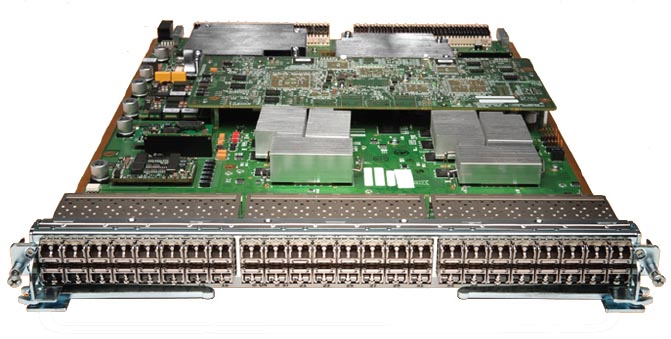
| Juniper Networks EX8200 48-port 100FX/1000BASE-X SFP line card; requires SFP optics sold separately |
#EX8200-48F
List Price: $32,000.00 |
|
More pricing below,
click here
EX8200-48F Overview:
The EX8200-48F is a 48-port 100BASE-FX/1000BASE-X line card with modular small form-factor pluggable transceiver (SFP)
interfaces for supporting a wide range of 100 Mbps or Gigabit Ethernet optical connections over multimode fiber,
single-mode fiber, or copper cabling. Designed for high-performance enterprise and service provider distribution applications,
the EX8200-48F also enables up to 384 line-rate ports in an EX8208 chassis, and 768 ports in an EX8216 chassis.
Juniper Networks EX8200 Ethernet line cards offer a variety of interfaces for supporting high-density 10/100/1000BASE-T,
100BASE-FX/ 1000BASE-X, and 10-Gigabit Ethernet deployments. Working with the Juniper Networks EX8208 Ethernet Switch
eight-slot and the Juniper Networks EX8216 Ethernet Switch 16-slot modular chassis, the EX8200 Ethernet line cards
offer a variety of flexible, high-density interfaces for high-performance data center and campus aggregation and
core environments.
The Juniper Networks EX8200 line of Ethernet switches offer powerful, modular platforms that deliver the performance,
scalability, and carrier-class reliability required for today’s high-density enterprise data center and campus aggregation
and core environments, as well as high-performance service provider interconnects.
EX8200 Ethernet line cards are specifically designed to optimize enterprise applications. Each EX8200 Ethernet line card
features an on-board Packet Forwarding Engine—the EX-PFE2—that is equipped with two purpose-built, application-specific
integrated circuits (ASICs), one to perform wire-speed packet processing at line rates, and another to perform internal
deep packet queuing and buffering while providing a high-speed interface to the chassis switch fabric. In addition, each line
card contains a local processor which provides scalable local control and status processing.
Features & Benefits:
The EX8200 PFE2 complex is comprised of two ASICs: the packet processor and the switch fabric interface. The hardware pipeline on
the packet processor ASIC supports approximately 960 Mpps of Layer 2 and Layer 3 IPv4 and IPv6 traffic in the EX8208, and more than
1900 Mpps in the EX8216. Wire-speed performance is maintained regardless of packet size, from 64- to 9216-byte jumbo frames across both
L2 and L3 interfaces. Firewall (access control list) filtering, marking, and rate limiting also occur at wire rate, with up to 64,000
entries across L2-L4 packet headers that can be applied per port, per VLAN, and per routed interface.
The packet processor ASIC also supports generic routing encapsulation (GRE) tunneling and two-label MPLS in hardware at line rate.
Additional packet processor ASIC capabilities include multiple queues for CPU-bound control traffic to protect the Routing Engine from
denial of service (DoS) attacks, with support for up to seven mirrored analyzer sessions directed to individual ports, VLANs, or tunneled
interfaces.
The switch fabric interface ASIC of the EX-PFE2 manages the large ingress and egress buffers that provide congestion avoidance and traffic
prioritization. On ingress, each switch fabric interface queues packets based on destination using dedicated high- and low-priority buffers
for each wire-speed, 10-Gigabit Ethernet egress port, or each group of 12 Gigabit Ethernet ports in the system. These weighted random early
detection (WRED) virtual output queues—up to 8,192 in an EX8216 chassis—prevent “head-of-line blocking” among ports on the same line card,
ensuring complete independence of traffic flows among all 10-Gigabit Ethernet ports in the system.
The switch fabric interface also manages the transfer of data across the distributed, single-tier crossbar switch fabric. Data is evenly
distributed across the fabric to balance traffic load and ensure graceful degradation of performance in the event of a non-redundant switch
fabric failure. Multicast traffic is also balanced across the system using the same line-rate, binary-tree replication process as the Juniper
Networks T Series Core Routers and the Juniper Networks MX Series Ethernet Services Routers, minimizing fabric congestion while reducing latency.
On egress, the switch fabric interface provides eight dedicated queues per port, mapped according to class of service (CoS) or DiffServ code
point (DSCP) values. A WRED scheduler is used for congestion avoidance within each queue, while administrator-configured strict and weighted
round-robin priority options are available between queues on a single port. Multicast traffic is managed independent of unicast traffic.
Total buffer size is 512 MB on each EX8200-8XS 10-Gigabit Ethernet port, and 42 MB on each EX8200-48T and EX8200-48F Gigabit Ethernet port,
providing 50-100 ms of bandwidth delay buffering. These deep buffers and ingress and egress queuing mechanisms are critical to managing
mission-critical data, handling bursty traffic, and reducing latency at the application level to free up bandwidth and allow a higher quantity
of both unicast and multicast application flows across the network.
All packets pass through the entire EX-PFE2 ingress pipeline, the switch fabric, and the EX-PFE2 egress pipeline. This consistency of packet
processing ensures that the EX-PFE2 is capable of delivering port-to-port latencies of under 10 μs, regardless of ingress or egress port location.
Up to 255 link aggregation groups (LAGs) are supported, ensuring that the large number of high-density Gigabit Ethernet LAGs found in campus
and data center core and aggregation deployments can be accommodated. Up to 12 ports may be bundled into a single LAG, allowing 120 Gbps logical
interfaces to be created using a full L2-L4 hash algorithm for optimal load balancing. Ports in a LAG may be distributed across line cards within
an EX8200 switch for an added level of resiliency. Automatic detection, recovery, and redistribution of LAG traffic in the event of a port, link,
or line card failure is supported for highly reliable connections.
Each line card contains a local CPU that is connected to the chassis’ redundant Routing Engines over dedicated internal gigabit control-plane
links. This CPU manages the local line card components, distributes forwarding table and other control plane data from the Routing Engine to the
local EX-PFE2 ASICs, and returns line card status and CPU-directed control plane packets to the Routing Engine. A second processor resident on each
line card aggregates flow-based statistics and analyzes sampled packets without impacting control plane performance. Finally, hot insertion and removal
of all line cards is supported for online maintenance and support.
| Features |
Description |
|
High availability |
- Hardware designed for continuous operation:
- Secure, modular architecture to isolate faults
- Separate control and forwarding planes to enhance scalability and resiliency
- Transparent failover and network recovery
- Graceful Route Engine Switchover (GRES)
- Nonstop Routing (NSR)
|
|
Layer 2 features |
- Jumbo frames (9216 byte)
- 4,096 VLANs
- VLAN Registration Protocol (GVRP)
- 802.3ad – Link Aggregation Control Protocol (LACP)
- 802.1D – Spanning Tree Protocol (STP)
- 802.1w – Rapid Spanning Tree (RSTP)
- 802.1s – Multiple Instance Spanning Tree (MSTP)
- Redundant Trunk Group (RTG)
- VLAN Spanning Tree Protocol (VSTP)
|
|
Layer 3 features |
- Static routing
- RIP v1/v2
- OSPF v2
- Virtual Router Redundancy Protocol (VRRP)
- BGP (Advanced Feature license)
- IS-IS (Advanced Feature license)
- IPv6 (Advanced Feature license roadmap)
- Bidirectional Forwarding Detection protocol (BFD)
|
|
Hardware tunneling |
- GRE tunnels (Advanced feature
license roadmap)
- MPLS capabilities (Advanced feature license roadmap)
|
|
Multicast |
- Internet Group Management Protocol (IGMP)
v1/v2/v3
- IGMP snooping
- Protocol Independent Multicast PIM-SM, PIM-SSM, PIM-DM, MSDP
|
|
Firewall filters |
- Ingress and egress L2-L4 access control lists (ACLs):
- Port ACLs
- VLAN ACLs
- Routed ACLs
- Control plane denial of service (DoS) protection
|
|
QoS |
- 2,000 policers
- 8 egress queues per port
- Weighted Random Early Drop (WRED) scheduling
- Scheduled Weighted Round Robin (SWRR) queuing
- Strict Priority queuing
- Egress per port and per queue shaping
- Multi-field classification (L2-L4) for scheduling and rewrite
|
Technical Specifications:
| Model: |
EX8200-48F |
 |
|
Physical Specifications |
|
Dimensions (W x H x D) |
14.40 x 1.59 x 20.51 in (36.58 x 4.04 x 52.09 cm) |
|
Weight |
13.26 lb (6.94 kg) |
|
Environment Ranges |
|
Operating Temperature |
32º to 104º F (0º to 40º C) |
|
Storage Temperature |
-40º to 158º F (-40º to 70º C) |
|
Relative Humidity (Operating) |
5% to 90% (noncondensing) |
|
Relative Humidity (Non-Operating) |
0% to 95% (noncondensing) |
|
Altitude (Operating) |
Up to 10,000 ft (3,048 m) |
|
Altitude (Non-Operating) |
Up to 16,000 ft (4,877 m) |
|
Hardware Specifications |
|
Port quantity |
48 |
|
Port type |
SFP |
|
Port speed |
100/1000 Mbps |
|
Max ports per system |
384 (EX8208); 768 (EX8216) |
|
Forwarding rate |
71 Mpps |
|
Data rate |
48 Gbps |
|
Fabric connection |
80 Gbps (160 Gbps full duplex) |
|
Queues per port |
8 |
|
Policers |
2,000 |
|
Total buffer size |
42 MB
per port |
|
Scheduler |
WRED,
SDWRR |
|
Jumbo frames |
9216
bytes |
|
LAG (ports/groups) |
12/255 |
|
MAC addresses |
160,000 |
|
VLANs |
4,096 |
|
IPv4 unicast routes |
512,000 |
|
IPv4 multicast routes |
128,000 |
|
IPv6 unicast routes* |
256,000 |
|
IPv6 multicast routes* |
128,000 |
|
Firewall filters (ACLs) |
54,000 entries |
|
ARP entries |
100,000 |
|
L3 next hops |
220,000 |
|
Number of multicast groups |
16,000 |
|
Analyzer sessions |
7
(local or remove) |
|
Max. power consumption |
330 W |
|
Line Card Capacity |
|
Maximum system throughput |
960
Mpps |
|
Switching capacity per line card |
320
Gbps (full duplex) |
|
Feature Specifications |
|
Layer 2 Switching |
- GVRP
- Physical port redundancy: redundant trunk group (RTG)
- STP/RSTP (802.1D-2004)
- VSTP (Compatible with PVST+)
- STP enable/disable per port
- MSTP (802.1Q-2003)
- Number of MST instances supported: 64
- Link Layer Discovery Protocol (LLDP)
- RVI (Routed VLAN Interface)
|
|
Layer 3 Features: IPv4 |
- Routing protocols: RIPv1/v2, OSPF v2, BGP, IS-IS
- Static routing
- Routing policy
- Bidirectional Forwarding Detection
- Layer 3 redundancy: VRRP
- Layer 3 sub-interfaces
- IP directed broadcast
|
Access Control Lists (ACLs) (JUNOS Software firewall filters)
- Port-based ACL (PACL):
ingress and egress
- VLAN-based ACL (VACL): ingress and egress
- Router-based ACL (RACL): ingress and egress
- ACL counters
- Layer 2-4 classification criteria: interface, media access control (MAC) address, Ethertype, 802.1p, VLAN, IP address, DSCP/IP Precedence, TCP/UDP port numbers
- Control Plane DoS protection
|
|
|
Link Aggregation |
- 802.3ad (LACP) support:
- Number of LAGs supported: 255
- Max number of ports per LAG: 12
- LAG load-sharing algorithm:
- IP: S/D MAC, S/D IP
- TCP/UDP: S/D MAC, S/D IP, S/D Port
- Non-IP: S/D MAC
- Tagged ports support in LAG
|
|
Quality of Service (QoS) |
- Ingress policing: single rate 2 color
- Hardware queues per port: 8
- Scheduling methods (egress): strict priority, shaped deficit weighted round-robin (SDWRR)
- Egress WRED: per queue per CoS threshold
- 802.1p, DSCP/IP Precedence trust, classification, and marking
- Layer 2-4 classification criteria: interface, MAC address, Ethertype, 802.1p, VLAN, IP address, DSCP/IP Precedence, TCP/UDP
port numbers
- CoS-based fabric ingress and egress queuing
|
|
Safety and Compliance |
|
Safety Certifications |
- CSA 60950-1 (2003) Safety of Information Technology Equipment
- UL 60950-1 (2003) Safety of Information Technology Equipment
- EN 60950-1 (2001) Safety of
Information Technology Equipment
- IEC 60950-1 (2001) Safety of Information Technology Equipment (with country deviations)
- EN 60825-1 +A1+A2 (1994) Safety of Laser Products—Part 1: Equipment Classification
- EN 60825-2 (2000) Safety of Laser Products—Part 2: Safety of Optical Fiber Comm. Systems
- C-UL to CAN/CSA 22.2
No.60950-1(First Edition)
- TUV/GS to EN 60950-1, Amendment A1-A4, A11
- CB-IEC60950-1, all country deviations
- CE
|
|
Electromagnetic Compatibility
(EMC) |
- EN 300 386 V1.3.3 (2005) Telecom Network Equipment—
EMC requirements
- FCC Part 15 Class A (2007) USA Radiated Emissions
- EN 55022 Class A (2006) European
Radiated Emissions
- VCCI Class A (2007) Japanese Radiated Emissions
- ICES-003 Class A
- AS/NZS CISPR 22 Class A
- CISPR 22 Class A
|
|
Immunity |
- EN 55024 +A1+A2 (1998) Information Technology Equipment Immunity Characteristics
- EN-61000-3-2 (2006) Power Line Harmonics
- EN-61000-3-3 +A1+A2+A3 (1995) Power Line Voltage Fluctuations
- EN-61000-4-2 +A1+A2 (1995) Electrostatic Discharge
- EN-61000-4-3 +A1+A2 (2002) Radiated Immunity
- EN-61000-4-4 (2004) Electrical Fast Transients
- EN-61000-4-5 (2006) Surge
- EN-61000-4-6 (2007) Immunity to Conducted Disturbances
- EN-61000-4-11 (2004) Voltage Dips and Sags
|
|
Customer-Specific Requirements |
- GR-63-Core (2006) Network Equipment, Building Systems (NEBS) Physical Protection
- GR-1089-Core (2006) EMC and Electrical Safety for Network Telecommunications Equipment
- SR-3580 (1995) NEBS Criteria Levels (Level 3) (pending)
|
|
Environmental |
Reduction of Hazardous Substances (ROHS) 5/6 |
|
Telco |
Common Language Equipment Identifier (CLEI) code |
* Roadmap
EX8200 Series Comparison Matrix:
| Model: |
EX8200-48T |
EX8200-48F |
EX8200-8SX |
 |
 |
 |
|
Port quantity |
48 |
48 |
8 |
|
Port type |
RJ-45 |
SFP |
SFP+ |
|
Port speed |
10/100/1000 Mbps |
100/1000 Mbps |
10 Gbps |
|
Max ports per system |
384 (EX8208); 768 (EX8216) |
64 (EX8208); 128 (EX8216) |
|
Forwarding rate |
71 Mpps |
71 Mpps |
119 Mpps |
|
Data rate |
48 Gbps |
48 Gbps |
80 Gbps |
|
Fabric connection |
80 Gbps (160 Gbps full duplex) |
160 Gbps (320 Gbps full duplex) |
|
Queues per port |
8 |
8 |
8 |
|
Policers |
2,000 |
2,000 |
2,000 |
|
Total buffer size |
42 MB
per port |
42 MB
per port |
512 MB
per port |
|
Scheduler |
WRED,
SDWRR |
WRED,
SDWRR |
WRED,
SDWRR |
|
Jumbo frames |
9216
bytes |
9216
bytes |
9216
bytes |
|
LAG (ports/groups) |
12/255 |
12/255 |
12/255 |
|
MAC addresses |
160,000 |
160,000 |
160,000 |
|
VLANs |
4,096 |
4,096 |
4,096 |
|
IPv4 unicast routes |
512,000 |
512,000 |
512,000 |
|
IPv4 multicast routes |
128,000 |
128,000 |
128,000 |
|
IPv6 unicast routes |
256,000 |
256,000 |
256,000 |
|
IPv6 multicast routes |
128,000 |
128,000 |
128,000 |
|
Firewall filters (ACLs) |
54,000 entries |
54,000 entries |
54,000 entries |
|
ARP entries |
100,000 |
100,000 |
100,000 |
|
L3 next hops |
220,000 |
220,000 |
220,000 |
|
Number of multicast groups |
16,000 |
16,000 |
16,000 |
|
Analyzer sessions |
7
(local or remove) |
7
(local or remove) |
7
(local or remove) |
|
Max. power consumption |
350 W |
330 W |
450 W |
|
EX8200 Line Cards |
| Juniper Networks EX8200 48-port 100FX/1000BASE-X SFP line card; requires SFP optics sold separately |
#EX8200-48F
List Price: $32,000.00 |
|
|